
Canada Time Zones Explained: Daylight Saving Time & Regional Differences
Updated: August 14, 2026
Canada is one of the world's largest countries by land area, so knowing Canada's time zones is important when planning a trip, booking flights, arranging airport transfers, or calling someone in another province.
Canada spans six main time zones, from Newfoundland Time in the east to Pacific Time in the west. The country also uses Daylight Saving Time (DST) in most regions, although the rules are not identical everywhere. Some provinces and territories stay on standard time year-round, while certain communities follow different local rules.
This guide explains Canada's time zones, UTC offsets, Daylight Saving Time dates, provincial differences, and practical tips for international travelers.

Travelers to Canada are astounded by the country's vast nature
How Many Time Zone in Canada?
Canada is not in one single time zone. It covers six primary time zones:
- Newfoundland Time
- Atlantic Time
- Eastern Time
- Central Time
- Mountain Time
- Pacific Time
This means there can be a four-and-a-half-hour difference between Newfoundland and British Columbia at certain times of the year.
The exact difference can depend on whether the locations are observing Daylight Saving Time.
What Are the Six Time Zones in Canada?
| Time Zone | Standard Time (Winter) | Daylight Time (Summer) | Main Areas | Example Cities |
| Pacific | UTC−8 (PST) | UTC−7 (PDT) | Most of British Columbia | Vancouver, Victoria |
| Mountain | UTC−7 (MST) | UTC−6 (MDT) | Alberta, parts of BC, Northwest Territories, parts of Nunavut | Calgary, Edmonton, Yellowknife |
| Central | UTC−6 (CST) | UTC−5 (CDT) | Manitoba, most of Saskatchewan, parts of Nunavut & Ontario | Winnipeg, Regina |
| Eastern | UTC−5 (EST) | UTC−4 (EDT) | Most of Ontario & Quebec, parts of Nunavut | Toronto, Ottawa, Montreal, Iqaluit |
| Atlantic | UTC−4 (AST) | UTC−3 (ADT) | New Brunswick, Nova Scotia, Prince Edward Island, most of Labrador | Halifax, Fredericton, Charlottetown |
| Newfoundland | UTC−3:30 (NST) | UTC−2:30 (NDT) | Island of Newfoundland + southeastern Labrador | St. John’s |
These six zones cover Canada's standard national time framework. However, actual local time can vary because some provinces and territories have exceptions to the usual DST schedule.
- Newfoundland is unique with its half-hour offset.
- Some provinces and territories straddle more than one zone (e.g., Nunavut has three; British Columbia and Ontario have exceptions).
- The total span from Pacific to Newfoundland is 4.5 hours.
Canada Time Zone Map
From west to east, Canada's main time zones are: Pacific → Mountain → Central → Eastern → Atlantic → Newfoundland
This broad east-west spread reflects Canada's enormous geographic size. Each move east generally advances the clock, although Newfoundland adds a half-hour rather than a full hour.
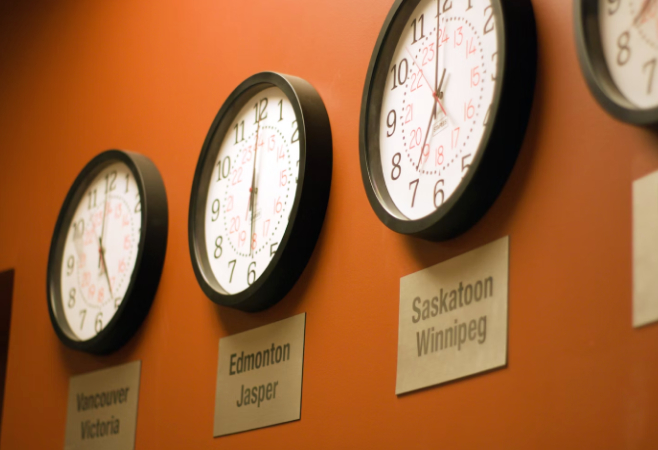
There are six different time zones in Canada
Does Canada Have Daylight Saving Time?
Yes. Daylight saving time in Canada involves moving clocks forward by one hour on the second Sunday in March and setting them back by one hour on the first Sunday in November.
What Is Daylight Saving Time in Canada?
Daylight Saving Time, commonly abbreviated as DST, is the practice of moving clocks forward by one hour during part of the year.
In most Canadian jurisdictions that observe DST:
- Clocks move forward one hour in March
- Clocks move back one hour in November
The standard Canadian schedule is to begin DST at 2:00 a.m. local time on the second Sunday in March and return to standard time at 2:00 a.m. local time on the first Sunday in November.
The purpose is to shift more daylight into the evening hours during the warmer months.
The clock moves forward by one hour, but the actual length of the day does not change.
When Does Daylight Saving Time Start and End in Canada?
For most Canadian regions that observe DST, the schedule is:
- Starts: Second Sunday in March
- Ends: First Sunday in November
At the transition in March, clocks move forward by one hour. At the November transition, clocks move backward by one hour.
When is Daylight Saving Time in Canada in 2026?
Most of Canada follows the North American DST schedule:
- Starts: Second Sunday in March — March 8, 2026. Clocks move forward 1 hour at 2:00 a.m. local time (becomes 3:00 a.m.).
- Ends: First Sunday in November — November 1, 2026. Clocks move back 1 hour at 2:00 a.m. local time (becomes 1:00 a.m.).
This schedule has been in place since 2007 and aligns with most of the United States.
Areas in Canada That Do Not Observe Daylight Saving Time
Several regions stay on the same time year-round:
Yukon: Permanent UTC−7 (often called Yukon Time or permanent Pacific Daylight Time) since 2020. No clock changes.
Most of Saskatchewan: Year-round Central Standard Time (UTC−6). This effectively puts the province on “permanent daylight” relative to its geographic Mountain Time zone. Exceptions exist around Lloydminster (which follows Alberta) and a few eastern communities.
British Columbia (most of the province): As of March 8, 2026, the majority of BC adopted permanent Pacific Time (UTC−7 year-round) after the final spring-forward. Some northeastern and southeastern communities (e.g., Dawson Creek, Fort Nelson, Creston areas) remain on Mountain Standard Time year-round.
Parts of Quebec, mainly along the Lower North Shore east of the 63rd meridian, remain on Atlantic Time without DST.
Parts of Nunavut, including Southampton Island, do not observe DST.
Specific communities in Ontario (e.g., Atikokan area) and small pockets elsewhere.
Always verify local rules for remote communities, as municipal decisions can create micro-exceptions.
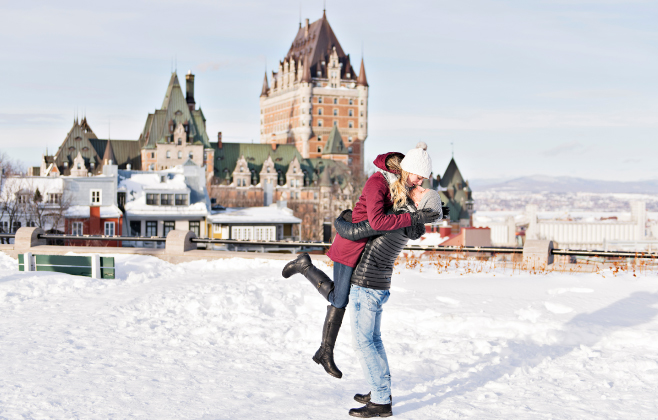
Daylight saving time in Canada involves moving clocks forward by one hour
Canada Time Zones by Major City
| City | Province/territory | Standard offset (winter) | Typical summer offset |
| Vancouver | British Columbia | UTC−7 (now fixed) | UTC−7 |
| Whitehorse | Yukon | UTC−7 (fixed) | UTC−7 |
| Edmonton / Calgary | Alberta | UTC−7 → UTC−6 (fixed from Nov 2026) | UTC−6 |
| Regina | Saskatchewan | UTC−6 (fixed) | UTC−6 |
| Winnipeg | Manitoba | UTC−6 | UTC−5 |
| Toronto / Ottawa | Ontario | UTC−5 | UTC−4 |
| Montreal | Quebec | UTC−5 | UTC−4 |
| Halifax | Nova Scotia | UTC−4 | UTC−3 |
| St. John's | Newfoundland and Labrador | UTC−3:30 | UTC−2:30 |
| Iqaluit | Nunavut (eastern) | UTC−5 | UTC−4 |
| Yellowknife | Northwest Territories | UTC−7 | UTC−6 |
What are the benefits?
The benefits of daylight saving time include a reduction of energy consumption through the minimization of the use of artificial lighting during summer when daylight is not limited. When the clock is adjusted to an hour ahead, it allows people to use longer daylight in the evenings and reduces the use of lighting electricity.
An increase in daylight hours in the evening might trigger individuals to venture out and engage in exercise, and this can reduce their chances of obesity and other health complications.
Many individuals are excited about the fact that the evenings in summer would have an hour more daylight, as it would mean that they have an opportunity to spend more time outside for leisure.
What are the downsides of daylight savings?
Daylight saving time has been associated with a number of safety issues, especially sleep disorders and the disruption of natural body cycles. Having an hour more or less of sleep can disrupt sleep patterns, leading to temporary fatigue and thus increasing the possibility of accidents and injuries.
Research shows that traffic accidents and incidents occurring in the workplace increase in the days after the time change. Lack of sleep or a disturbed circadian rhythm may reduce alertness and increase the likelihood of errors
In addition, others can even consider it uncomfortable, considering the sudden change to daylight, particularly individuals who are sensitive to light and dark. It can also lead to increased odds of road accidents, particularly in the morning and evening when it is poorly visible during rush hour.
Canada aligned its DST schedule with the United States for consistency in trade and communication
Practical Tips for Travelers Dealing With Canadian Time Zones
Canada's multiple time zones can affect flights, hotel bookings, tours, road trips, and international calls. These simple tips can help you avoid common mistakes:
Check the destination's local time: Canada has six main time zones, and some provinces and territories have more than one. Always check the specific city or town rather than relying only on the province.
Check flight times carefully: Airline tickets normally show local departure and arrival times. You do not need to manually add or subtract the time difference.
Be aware of Daylight Saving Time: DST rules vary across Canada. Check the current rules for your destination, especially around the March and November clock changes.
Watch for Newfoundland's half-hour offset: Newfoundland Time differs from Atlantic Time by 30 minutes, so allow for the extra half hour when planning calls or travel.
Use automatic time settings: Set your phone and other devices to update the time zone automatically when traveling between provinces.
Confirm meeting and booking times: When scheduling calls, tours, or appointments, state the city or time zone clearly, such as "2 p.m. Toronto time."
Check long-distance transport: Trains and buses may cross several time zones. Confirm whether departure and arrival times are shown in local time.
Allow extra time during clock changes: The March DST transition means losing one hour, which can affect sleep and early-morning travel plans.
Use a reliable time-zone source: Before important travel or meetings, verify the local time and current DST rules with an official Canadian source or a trusted time-zone service.
Frequently Asked Questions About Canada Time Zones
How many time zones does Canada have?
Canada has six main time zones: Pacific, Mountain, Central, Eastern, Atlantic, and Newfoundland. The country spans a 4.5-hour time difference from the Pacific coast to Newfoundland.
Does all of Canada observe Daylight Saving Time?
No. Most of Canada observes Daylight Saving Time (DST), but there are exceptions. Yukon and most of Saskatchewan stay on the same time year-round, while some communities in British Columbia, Quebec, and Nunavut follow different rules.
Why does Newfoundland have a 30-minute time difference?
Newfoundland uses a half-hour offset: UTC−3:30 during standard time and UTC−2:30 during daylight time. This makes Newfoundland Time different from Canada's other main time zones.
What is Canada's easternmost time zone?
Newfoundland Time is Canada's easternmost time zone. It is UTC−3:30 during standard time and UTC−2:30 during daylight time.
What is Canada's westernmost time zone?
Pacific Time is Canada's westernmost main time zone. It is UTC−8 during standard time and UTC−7 during daylight time.
Ready To Explore Time Zones In Canada?
Experience the wonders of Canada's diverse landscapes and vibrant culture! Whether you're planning to witness the sunset on the Pacific coast or greet the sunrise in the Atlantic, your Canadian adventure awaits.
To ensure a seamless journey, apply for your Canada Electronic Travel Authorization (eTA) today through our trusted platform at the Canadian Immigration Services website. Simplify your travel arrangements and get ready to immerse yourself in the beauty of Canada's time zones.
Don't miss out on the opportunity to the best places to visit in Canada for your vacation. Start your eTA application now and set the wheels in motion for an unforgettable Canadian escapade!